
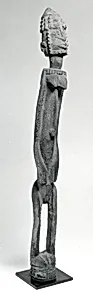
Figure
Unknown Artist
15th–19th century
Medium
Wood, pigment
Dimensions
H x W x D: 25 1/8 x 2 5/8 x 3 1/4in. (63.8 x 6.7 x 8.3cm)
Classification
Wood-Sculpture
Culture
Dogon peoples
Department
Arts of Africa, Oceania, and the Americas
Museum
Metropolitan Museum of Art, New York, NY
Credit
Gift of Lester Wunderman, 1985
Accession Number
1985.422.3
Rights
Public Domain
Art Historical Context
This striking wooden figure, carved by an unknown Dogon artist between the 15th and 19th centuries, hails from the Dogon peoples of Mali in West Africa. The Dogon are renowned for their cliffside villages in the Bandiagara Escarpment and a rich cosmology intertwined with ancestor veneration, agriculture, and spiritual rituals. Such figures often served as protective altarpieces or representations of ancestral spirits (altars), placed on household shrines to invoke blessings for fertility, health, and prosperity. Crafted from wood and adorned with pigment, the sculpture exemplifies Dogon artistic techniques: intricate carving that emphasizes elongated proportions, stylized features, and symbolic gestures, with pigments enhancing spiritual potency and visual impact. At 25 1/8 inches tall, its slender form (just 2 5/8 x 3 1/4 inches wide and deep) suggests it was designed for intimate, sacred use rather than public display. The enduring style across centuries reflects the Dogon's conservative artistic traditions, preserving cultural knowledge through generations. A generous gift to the Metropolitan Museum of Art from Lester Wunderman in 1985, this figure invites us to ponder the profound role of art in Dogon life—bridging the living and the divine in a timeless dialogue.