
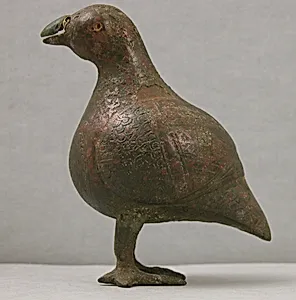
Figure
Unknown Artist
11th–12th century
Medium
Bronze; cast and engraved
Dimensions
H. 4 3/16 in. (10.6 cm) W. 3 7/16 in. (8.7 cm) D. 2 1/4 in. (5.7 cm) Wt. 6.9 oz. (195.6 g)
Classification
Metal
Department
Islamic Art
Museum
Metropolitan Museum of Art, New York, NY
Credit
Fletcher Fund, 1975
Accession Number
1975.318
Rights
Public Domain
Tags
Art Historical Context
Nestled in the Metropolitan Museum of Art's Islamic collection, this enchanting bronze *Figure* from the th–12th century captures the refined artistry of the medieval Islamic world. Standing just over 4 inches tall, this petite sculpture—cast in bronze and meticulously engraved—likely depicts a bird, a motif rich with symbolism in Islamic culture, evoking themes of freedom, the divine, or paradise gardens as described in poetry and scripture. Crafted through lost-wax casting, a sophisticated technique that allowed for intricate hollow forms, the artist then added fine engravings to enhance details like feathers or plumage. This combination of methods highlights the technical mastery of Islamic metalworkers during a golden age of craftsmanship, from regions like Persia or the Levant, where such objects adorned homes, served as talismans, or marked elite status. Weighing a mere 6.9 ounces, its portability suggests it was treasured as a personal artifact rather than monumental art. Acquired through the Fletcher Fund in 1975, this anonymous masterpiece invites us to ponder the anonymous genius behind it, bridging centuries to reveal the enduring beauty of Islamic artistic heritage.