
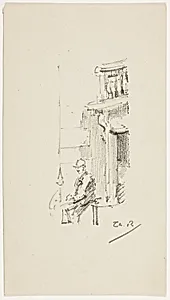
Figure and Doorway
1890–94
Medium
Transfer lithograph in black on cream wove paper
Dimensions
Image: 9.3 × 4.6 cm (3 11/16 × 1 13/16 in.); Sheet: 16.5 × 9.2 cm (6 1/2 × 3 5/8 in.)
Classification
lithograph
Department
Prints and Drawings
Museum
Art Institute of Chicago
Accession Number
211086
Rights
Public Domain
Art Historical Context
Theodore Roussel’s *Figure and Doorway* (1890–94) is a delicate transfer lithograph that captures the quiet intimacy of late nineteenth-century printmaking. Roussel, a British artist associated with the etching revival and closely linked to James McNeill Whistler, embraced lithography as a medium that allowed for fluid, atmospheric effects on a miniature scale. The work’s tiny image—just over three by one-and-three-quarter inches—invites close viewing, drawing the eye into a spare composition of a solitary figure beside an open doorway rendered in soft blacks against cream paper. Transfer lithography enabled Roussel to work directly on specially prepared paper before transferring the design to the stone, giving the print the spontaneity of a drawing while preserving the crisp tonal range unique to the medium. This technique was especially valued during the 1890s, when artists sought new ways to disseminate original work to wider audiences without sacrificing artistic quality. Today the lithograph resides in the Art Institute of Chicago’s collection of prints and drawings, where its modest size and restrained elegance continue to exemplify the refined aesthetic of the period’s printmakers.
About the Artist
Theodore Roussel · 1847–1926
Theodore Casimir Roussel was born on 23 March 1847 in Lorient, Brittany, France, into a naval family. After serving in the Franco-Prussian War, he began painting in 1872 as an entirely self-taught artist, initially rendering scenes of daily life in the meticulous style of the Old Masters. In 1878, he settled permanently in London, where he immersed himself in the vibrant British art scene. There, ...