
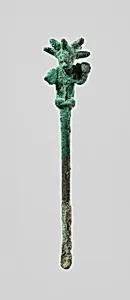
Figure Lime Spoon
Unknown Artist
15th–16th century
Medium
Copper
Dimensions
H. 3/8 × W. 1/2 × D. 3 in. (1 × 1.3 × 7.6 cm)
Classification
Metal-Implements
Culture
Inca
Department
Arts of Africa, Oceania, and the Americas
Museum
Metropolitan Museum of Art, New York, NY
Credit
Bequest of Jane Costello Goldberg, from the Collection of Arnold I. Goldberg, 1986
Accession Number
1987.394.589
Rights
Public Domain
Art Historical Context
This delicate **Figure Lime Spoon**, crafted by an unknown Inca artist in the 15th–16th century, exemplifies the metalworking of the Inca Empire, which flourished in the Andes before the Spanish conquest. Made of copper—a metal abundant in the region and prized for its malleability—this tiny implement (just 3/8 × 1/2 × 3 inches) was both functional and artistic. The spoon's handle likely features a figurative motif, a common Inca motif blending utility with symbolic representation, reflecting their mastery of lost-wax casting and repoussé techniques. Lime spoons like this were essential tools in Inca daily life and ritual. Used to scoop lime (calcium oxide) mixed with coca leaves, they enhanced the stimulant's effects, aiding laborers in high-altitude agriculture and warriors on long marches. Coca consumption was sacred, tied to Pachamama (Mother Earth) worship, underscoring the object's cultural significance beyond mere practicality. Housed in The Metropolitan Museum of Art's Department of the Arts of Africa, Oceania, and the Americas, this piece from the bequest of Jane Costello Goldberg highlights Inca ingenuity in transforming everyday objects into portable art. Its survival offers a glimpse into a sophisticated society where even the smallest tools embodied spiritual and social values.