
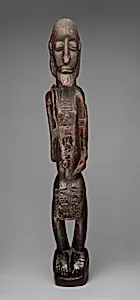
Figure: Male
12th–17th century (?)
Medium
Wood
Dimensions
H. 25 3/8 x W. 3 7/8 x D. 4 5/8 in. (64.5 x 9.9 x 11.8 cm)
Classification
Wood-Sculpture
Culture
Dogon peoples (?)
Department
Arts of Africa, Oceania, and the Americas
Museum
Metropolitan Museum of Art, New York, NY
Credit
Gift of Lester Wunderman, 1985
Accession Number
1985.422.2
Rights
Public Domain
Tags
Art Historical Context
This striking wooden sculpture, titled *Figure: Male*, was crafted by a Soninke artist, possibly associated with the Dogon peoples West Africa, during the uncertain span of the 12th to 17th century. at 25 3/8 inches tall, this slender figure exemplifies the masterful wood-carving traditions of the region, where artisans transformed local hardwoods into enduring symbols of human form. Housed in the Metropolitan Museum of Art's Department of Arts of Africa,, and the Americas, entered the collection as a gift from Lester Wunderman in 1985. In Dogon and Soninke cultures, such abstract male figures often held profound spiritual significance, likely representing ancestors or protective spirits in rituals and domestic shrines. The sculpture's elongated proportions and simplified features reflect the stylistic abstraction common in West African art, emphasizing symbolic essence over naturalistic detail. Carved with precise tools, the wood's patina from age and handling speaks to its ritual life, inviting viewers to ponder the continuity of African artistic heritage across centuries. Though exact provenance remains elusive, this piece bridges medieval West African traditions, showcasing the ingenuity of Soninke-Dogon sculptors in capturing the human spirit through humble materials. A testament to cultural resilience, it reminds us of the artistry thriving in the cliffs and savannas of Mali long before European contact.