
Figure of a Man
1612–66
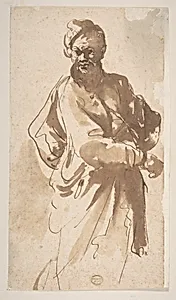
Medium
Pen and brown ink, brush and brown wash
Dimensions
10 13/16 x 9 11/16in. (27.4 x 24.6cm)
Classification
Drawings
Department
Drawings and Prints
Museum
Metropolitan Museum of Art, New York, NY
Credit
Gift of Cornelius Vanderbilt, 1880
Accession Number
80.3.454
Rights
Public Domain
Tags
Art Historical Context
**Figure of a Man** by Pier Francesco Mola (2–1666) is a captivating 17th drawing that exemplifies the Baroque era's mastery of the human form. Created with pen and brown ink accented by brush and brown, this intimate study measures about 11 by 10 inches and captures a male figure with fluid lines and subtle tonal modeling. Mola, an Italian artist of Swiss origin who trained in Rome and worked in Lombardy, was renowned for his dynamic figure drawings, often preparatory sketches for larger paintings influenced by the dramatic naturalism of Caravaggio and the Bolognese school. The medium's significance lies in its versatility: the fine pen lines define contours and details, while the brown wash adds depth and volume, evoking light and shadow in a way that brings the subject to life. Such techniques were essential for Baroque artists, allowing rapid exploration of poses and expressions before committing to oil on canvas. Though tagged as a portrait-like depiction, it likely served as a modello—a model drawing—for Mola's history scenes or religious works, highlighting the period's emphasis on anatomical precision and emotional intensity. Generously gifted to the Metropolitan Museum of Art by Cornelius Vanderbilt in 1880, this piece from the Drawings and Prints department invites visitors to appreciate the artistry behind the grand paintings of the Baroque age. It's a window into an artist's studio, where every stroke reveals the pursuit of perfection.
About the Artist
Pier Francesco Mola · 1612–1666
Pier Francesco Mola (1612–1666) was a Roman Baroque painter celebrated for the lyrical quality of his landscapes and the painterly freedom of his figural work, qualities that set him apart from the more rigorous classicism of some of his contemporaries. Born in Coldrerio in the Swiss canton of Ticino, he spent the greater part of his career in Rome, where he underwent an extensive and eclectic for...