
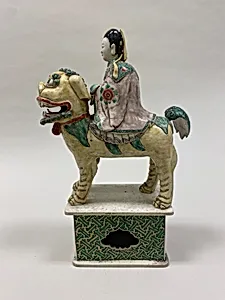
Figure of Bodhisattva Guanyin riding a lion
Unknown Artist
early 18th century
Medium
Porcelain painted in polychrome enamels over the biscuit (Jingdezhen ware)
Dimensions
(a) Figure: H. 10 1/4 in. (26 cm); (b) base: H. 4 in. (10.2 cm); L. 6 5/8 in. (16.8); (c) removable tail: L. 2 1/8 in. (5.4 cm)
Classification
Ceramics
Culture & Period
China · Qing dynasty (1644–1911), Kangxi period (1662–1722)
Department
Asian Art
Museum
Metropolitan Museum of Art, New York, NY
Credit
Gift of Edwin C. Vogel, 1962
Accession Number
62.222.10a–c
Rights
Public Domain
Tags
Art Historical Context
This exquisite porcelain figure depicts Bodhisattva Guanyin, the compassionate savior in Chinese Buddhism, riding a lion—a dynamic pose symbolizing protection and divine power. Crafted in the early 18th century during the Kangxi period (1662–1722) of the Qing dynasty, it hails from Jingdezhen, China's imperial porcelain capital renowned for its technical mastery. Standing about 10 inches tall on a separate base, with a removable tail for the lion, the sculpture captures Guanyin's serene grace amid the beast's ferocity, reflecting Buddhist iconography popular among Qing elites and devotees. The artwork showcases innovative polychrome enamel painting over biscuit porcelain—an unglazed, matte body that provided a canvas-like surface for vibrant, detailed overglaze colors. This technique, perfected at Jingdezhen under Kangxi patronage, allowed for lifelike shading and intricate patterns, elevating ceramics to sculptural art. Such pieces were prized in temples and scholarly collections, blending spirituality with imperial luxury. A gift to the Metropolitan Museum of Art in 1962, this rare figure highlights the Kangxi era's porcelain renaissance, where technical virtuosity met profound cultural reverence for Guanyin, embodying mercy in turbulent times.