
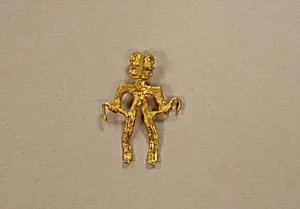
Figure Pendant
Unknown Artist
8th–16th century
Medium
Gold (cast)
Dimensions
Height 1-3/16 in. (3 cm)
Classification
Metal-Ornaments
Culture
Costa Rica (?)
Department
Arts of Africa, Oceania, and the Americas
Museum
Metropolitan Museum of Art, New York, NY
Credit
Bequest of Alice K. Bache, 1977
Accession Number
1977.187.24
Rights
Public Domain
Tags
Art Historical Context
This exquisite **Figure Pendant**, crafted from cast gold, hails from ancient Costa Rica (or nearby regions) between the 8th and 16th centuries—a span encompassing vibrant pre-Columbian cultures renowned for their mastery of metallurgy. Measuring just 1-3/16 inches (3 cm) tall, this diminutive human figure was likely worn as personal adornment, perhaps suspended from a necklace, symbolizing status, spirituality, or ancestral connections in daily or ritual life. The use of gold, a precious metal symbolizing the sun and divine power in many Mesoamerican and Central American societies, underscores the artisan's skill in lost-wax casting—a sophisticated technique where wax models were encased in clay, melted out, and replaced with molten gold. Though the exact culture remains uncertain, such pendants reflect the ingenuity of indigenous goldworkers in the Greater Nicoya area, who produced intricate ornaments blending human forms with symbolic motifs. Bequeathed to the Metropolitan Museum of Art in 1977 by Alice K. Bache, this rare survivor offers a glimpse into the artistic traditions of pre-Hispanic Costa Rica, highlighting how small-scale jewelry encapsulated profound cultural values amid the region's rich biodiversity and trade networks.