
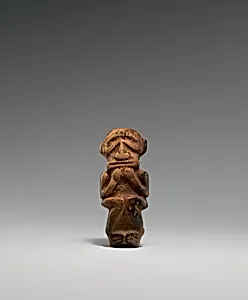
Figure Pendant
Unknown Artist
13th–15th century
Medium
Bone
Dimensions
H. 4 1/4 in. (10.8 cm)
Classification
Stone-Ornaments
Culture
Taíno
Department
Arts of Africa, Oceania, and the Americas
Museum
Metropolitan Museum of Art, New York, NY
Credit
Purchase, Mary R. Morgan, Mary O'Boyle II and Mr. and Mrs. Frederick E. Landmann Gifts; The Michael C. Rockefeller Memorial Collection, Gift of Nelson A. Rockefeller and Bequest of Nelson A. Rockefeller, by exchange, and Gift of Nathan Cummings, by exchange, 1982
Accession Number
1982.48.5
Rights
Public Domain
Art Historical Context
This exquisite Figure Pendant, crafted from bone by an unknown Taíno artist the 13th and 15th centuries, exemplifies masterful carving traditions of the indigenous Taíno people of the Caribbean. Measuring just 4¼ inches (10.8 cm) in height, its compact form suggests it was designed as a wearable ornament, likely suspended from a cord for personal adornment or ritual use. The Taíno, skilled artisans who flourished in the Greater Antilles before European contact, often transformed natural materials like bone—sourced from animals such as manatees or birds—into intricate personal objects that bridged the everyday and the spiritual. Bone's durability and fine grain made it ideal for detailed sculpting, allowing Taíno makers to capture stylized human or supernatural figures with fluid lines and symbolic motifs. Such pendants held profound cultural importance, possibly representing ancestors, deities, or protective spirits (zemis) central to Taíno cosmology and social rituals. This piece, now in the Metropolitan Museum of Art's Department of the Arts of Africa, Oceania, and the Americas, reflects the sophistication of pre-Columbian artistry and offers a tangible link to a vibrant civilization. (198 words)