
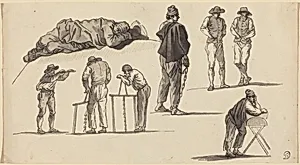
Figure Studies, Including One Man Sleeping on the Ground and Two Men Sawing
1701 to 1725
Medium
pen and black ink with gray wash on laid paper
Dimensions
sheet: 12.8 x 23.3 cm (5 1/16 x 9 3/16 in.)
Classification
Drawing
Department
CG-E
Museum
National Gallery of Art, Washington, D.C.
Credit
Joseph F. McCrindle Collection
Accession Number
2009.70.240
Rights
Public Domain
Art Historical Context
Claude-Joseph Vernet’s *Figure Studies, Including One Man Sleeping on the Ground and Two Men Sawing* offers a charming glimpse into the artist’s early practice. Created between 1701 and 1725, when Vernet was still developing his celebrated landscape and marine paintings, this modest sheet captures everyday human activity with lively precision. Using pen and black ink with gray wash on laid paper, Vernet quickly recorded three figures in contrasting poses—one reclining in rest, the others engaged in the rhythmic labor of sawing—demonstrating his keen eye for gesture and movement. Such drawings were essential tools for an 18th-century artist preparing larger compositions. Vernet, who would become famous for infusing his coastal scenes with naturalistic staffage, used these studies to understand how figures could animate a landscape and convey scale. The economical technique of ink and wash allowed him to explore light and shadow while focusing on the expressive potential of ordinary people at work or rest. Today preserved in the National Gallery of Art’s Joseph F. McCrindle Collection, the drawing reveals Vernet’s lifelong interest in observed reality. Though small in scale, it highlights the quiet significance of preparatory works that underpinned the graceful, light-filled paintings for which he is best remembered.
About the Artist
Claude-Joseph Vernet · 1714–1789
Claude-Joseph Vernet and his direct descendants are the last representatives of the Avignon School which had provided a continuous line of artists since the 14th century. It originated at the time when Bernard de Goth, Archbishop of Bordeaux, became pope in the name of Clement V and transferred the seat of the papacy to Avignon where he established an influential artistic community. Comment on wor...