
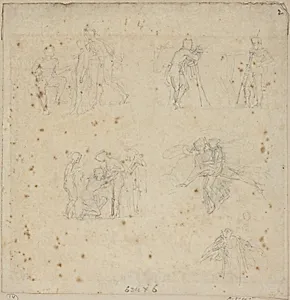
Figure Studies
1751 to 1775
Medium
graphite on laid paper
Dimensions
overall: 17.9 x 17.8 cm (7 1/16 x 7 in.)
Classification
Drawing
Department
CG-E
Museum
National Gallery of Art, Washington, D.C.
Credit
Rosenwald Collection
Accession Number
1980.45.523
Rights
Public Domain
Art Historical Context
John Flaxman's *Figure Studies* (ca. 1751–1775) offers a captivating glimpse into the preparatory world of one of Britain's leading Neoclassical artists. Rendered in graphite on laid paper—a fine, handmade sheet typical of 18th-century draftsmanship—this intimate drawing measures just 17.9 x 17.8 cm, perfect for an artist's sketchbook. Flaxman, renowned for his elegant sculptures and illustrations of classical texts like Homer's *Iliad* and *Odyssey*, used such studies to refine his command of the human figure, blending anatomical precision with graceful, idealized forms inspired by ancient Greek and Roman art. These sketches exemplify the Neoclassical emphasis on clarity, proportion, and moral elevation, bridging the Rococo's frivolity with emerging Romantic sensibilities. As a sculptor and designer, Flaxman often began with quick, expressive graphite lines to capture movement and pose, laying the groundwork for monumental works like his Wedgwood cameos or tomb sculptures. Housed in the National Gallery of Art's Rosenwald Collection (Department CG-E), this piece highlights the era's reverence for drawing as both a technical exercise and a creative spark. Visitors will appreciate how Flaxman's fluid lines evoke timeless vitality, inviting us to trace the evolution from raw study to polished masterpiece.
About the Artist
John Flaxman · 1755–1826
John Flaxman (1755–1826) was born in York, England, the son of John Flaxman Sr., a moulder and seller of plaster casts who ran a studio in London's Covent Garden. Largely self-taught amid his father's stock of classical casts, with minimal formal schooling due to childhood illness, Flaxman displayed prodigious talent early on. At age 12, he won a Society of Arts prize for a medallion; by 15, anoth...