
Figure Study
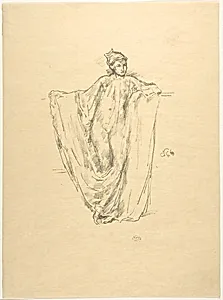
Medium
Lithograph on beige Japanese paper
Dimensions
Image: 19 × 14.5 cm (7 1/2 × 5 3/4 in.); Sheet: 31.3 × 23.2 cm (12 3/8 × 9 3/16 in.)
Department
Prints and Drawings
Museum
Art Institute of Chicago
Accession Number
185286
Rights
Public Domain
Art Historical Context
James McNeill Whistler’s *Figure Study* (1894) is a delicate lithograph created during the artist’s mature phase, when he was celebrated for his innovative printmaking. Printed on beige Japanese paper—a nod to Whistler’s lifelong fascination with Japanese aesthetics and ukiyo-e woodblock prints—this work exemplifies his shift toward subtle, atmospheric effects in black-and-white media. Measuring a modest 19 × 14.5 cm for the image, it captures the intimacy of a figure study, likely exploring form and pose with Whistler’s characteristic economy of line. Whistler, an American expatriate in Britain, championed the Aesthetic movement, prioritizing “art for art’s sake” over narrative. His lithographs from the 1890s, including this one, often employed transfer lithography—a technique where drawings were traced onto stone for reproduction—allowing fluid, painterly marks that blurred the line between drawing and print. This piece reflects his tonal harmony, influenced by Japanese subtlety and Velázquez’s mastery, making it a gem in the Art Institute of Chicago’s Prints and Drawings collection. Visitors will appreciate how *Figure Study* reveals Whistler’s experimental spirit: affordable yet exquisite, it brought fine art to broader audiences amid the fin-de-siècle print revival. A testament to his enduring influence on modern graphic arts.
About the Artist
James McNeill Whistler · 1834–1903
James Abbott McNeill Whistler (1834-1903) was an American-born painter and printmaker who became a leading figure in the Aesthetic Movement and pioneer of Tonalism and Japonisme. He revolutionized art by championing "art for art's sake" and treating paintings as visual equivalents of musical compositions, titling works as "arrangements," "harmonies," and "nocturnes" to emphasize formal qualities o...