
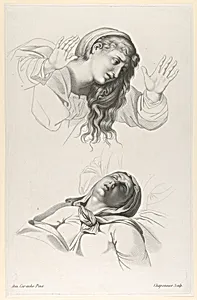
Figures from Annibale Carracci's "The Deposition"
Medium
Engraving and stipple
Dimensions
Plate: 16 13/16 × 10 13/16 in. (42.7 × 27.4 cm) Sheet: 17 × 11 in. (43.2 × 27.9 cm)
Classification
Prints
Department
Drawings and Prints
Museum
Metropolitan Museum of Art, New York, NY
Credit
Harris Brisbane Dick Fund, 1953
Accession Number
53.600.1169(46)
Rights
Public Domain
Tags
Art Historical Context
This poignant engraving, *Figures from Annibaleacci's "The Deposition"*, captures a moment of profound grief from the biblical scene of Christ's body being lowered from the cross. Created by French printmaker Alexandre Chaponnier 1791 and 1801, it reproduces elements of the original work by the eminent Bolognese artist Annibale Carracci (1560–1609), a key figure in the transition from Mannerism to Baroque art. Carracci's naturalistic style, emphasizing emotional depth and human form, shines through in the sorrowful expressions of the women, evoking universal themes of loss and mourning as highlighted by the artwork's tags. Chaponnier employs engraving and stipple techniques—incised lines combined with fine dots for subtle shading—to faithfully translate Carracci's dramatic composition into print form. Stipple, popular in the late 18th century, excels at rendering soft textures like skin and fabric folds, allowing for rich tonal gradations that heighten the emotional intensity. Measuring about 17 by 11 inches on its sheet, this print from the Metropolitan Museum of Art's Drawings and Prints collection exemplifies how reproductive prints democratized access to Renaissance and Baroque masterpieces during the Enlightenment era. Held in the Met thanks to the Harris Brisbane Dick Fund of 1953, this work invites visitors to reflect on art's power to convey shared human sorrow across centuries, bridging Carracci's 16th-century innovation with 19th-century printmaking artistry.