
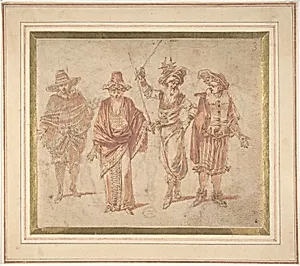
Figures in Theatrical Costumes
Medium
Pen and brown ink, brush and red wash, over red chalk
Dimensions
6 1/16 x 7 7/8 in. (15.4 x 20.0 cm)
Classification
Drawings
Department
Drawings and Prints
Museum
Metropolitan Museum of Art, New York, NY
Credit
Rogers Fund, 1906
Accession Number
06.1042.7
Rights
Public Domain
Tags
Art Historical Context
This delicate drawing, *Figures in Theatrical Costumes*, captures the lively spirit of early eighteenth-century French theater through its depiction of men in elaborate period attire, complete with swords and dramatic poses. Created with pen and brown ink, brush and red wash over red chalk, the work showcases the fluid, expressive techniques favored by artists of the time for capturing movement and texture in costume studies. The small scale—roughly six by eight inches—suggests it may have served as a preparatory sketch, allowing the artist to experiment with drapery, gesture, and character before larger projects. The piece reflects the close artistic relationship between Claude Gillot and his pupil Antoine Watteau. Gillot, renowned for his scenes drawn from commedia dell’arte and opera, introduced Watteau to the theatrical world that would later define the younger artist’s Rococo fêtes galantes. Such drawings highlight the era’s fascination with performance as both entertainment and social commentary, where costumes conveyed status, emotion, and narrative at a glance. Acquired by the Metropolitan Museum of Art in 1906 through the Rogers Fund, the sheet offers modern viewers an intimate glimpse into the creative process behind the vibrant stage designs of Louis XIV’s and Louis XV’s France. Its warm red tones and dynamic lines continue to convey the energy of live performance centuries later.
About the Artist
Claude Gillot|Antoine Watteau · 1673–1722
Artist known for his elegant designs done in the Rococo manner of Audran; also for his predilection for scenes from the 'comedia dell'arte.' Few paintings survive; his work is known mainly through drawings and etchings. Comment on works: Genre; History