
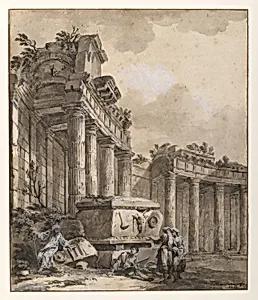
Figures near a Ruined Colonnade
Classification
architecture
Department
Smithsonian Collection
Museum
Smithsonian American Art Museum
Credit
Gift of Mrs. Howard J. Sachs and Mr. Peter G. Sachs in memory of Miss Edith L. Sachs
Accession Number
1978-168-42
Rights
Public Domain
About this artwork
Research in Progress
Art Historical Context
**Figures near a Ruined Colonnade** (1761) by Charles-Louis Clérisse captures the allure of antiquity through a poised architectural scene. The French artist (1721–1820), renowned for his meticulous renderings of classical ruins, places small figures amid a crumbling colonnade, evoking the grandeur and decay of ancient Rome. Created during the height of the 18th-century Grand Tour era, when European artists flocked to Italy to study and sketch historical sites, this work reflects the Enlightenment fascination with classical architecture as a source of inspiration for modern design. Classified as architecture within the Smithsonian American Art Museum's collection—gifted by Mrs. Howard J. Sachs and Mr. Peter G. Sachs in memory of Miss Edith L. Sachs—Clérisseau's piece exemplifies his pioneering role in neoclassical draughtsmanship. Though the medium remains under study ("Research in Progress"), such works often employed ink, wash, or gouache to convey texture and light on weathered stone, blending precise observation with romantic atmosphere. Clérisseau's influence extended to figures like Thomas Jefferson, underscoring the artwork's bridge between European antiquarianism and emerging American neoclassicism. This evocative composition invites visitors to ponder time's passage, reminding us how ruins sparked a revival of classical ideals in art and architecture. A testament to enduring curiosity, it highlights the Smithsonian's commitment to preserving these historical visions.