
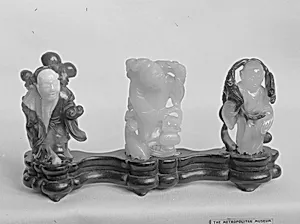
清晚期 玉、瑪瑙道家人物|Figures of Daoist deities
Unknown Artist
19th century
Medium
Jade (nephrite) and agate
Dimensions
H. 1 7/8 in. (4.8 cm); W. 2 1/8 in. (5.4 cm); D. 2 in. (5.1 cm)
Classification
Hardstone
Culture & Period
China · Qing dynasty (1644–1911)
Department
Asian Art
Museum
Metropolitan Museum of Art, New York, NY
Credit
Gift of Heber R. Bishop, 1902
Accession Number
02.18.877a–c
Rights
Public Domain
Tags
Art Historical Context
This exquisite carving, titled *Figures of Daoist Deities*, hails from late Qing dynasty China (19th century) and showcases masterful work in nephrite jade and agate. Measuring just under 2 inches in height, width, and depth, this compact hardstone sculpture depicts male and female Daoist figures, likely immortals or deities revered in Taoist tradition. The unknown artist's skill is evident in the intricate detailing of flowing robes, serene expressions, and dynamic poses, all rendered within such a diminutive scale. Jade, particularly nephrite, held profound cultural significance in imperial China as a symbol of purity, immortality, and moral virtue—qualities aligned with Daoist philosophy emphasizing harmony with the universe. Agate adds vibrant contrasts, enhancing the deities' ethereal presence. Such carvings were prized by scholars and elites for personal altars, seals, or adornments, reflecting the Qing era's refined lapidary traditions despite political turbulence. Today, this gift from Heber R. Bishop in 1902 graces the Metropolitan Museum of Art's Asian Art collection, offering visitors a tangible glimpse into China's spiritual artistry and enduring reverence for the divine.