
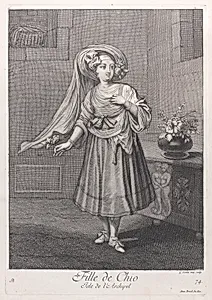
Fille de Chio, Isle de l'Archipel, plate 74 from "Recueil de cent estampes représentent differentes nations du Levant"
Medium
Etching and engraving
Dimensions
Sheet: 16 1/2 in. × 12 in. (41.9 × 30.5 cm) Plate: 14 1/8 × 9 13/16 in. (35.9 × 25 cm)
Classification
Prints
Department
Drawings and Prints
Museum
Metropolitan Museum of Art, New York, NY
Credit
Bequest of Mrs. Charles Wrightsman, 2019
Accession Number
2019.282.89
Rights
Public Domain
Tags
Art Historical Context
**Fille de Chio, Isle de l'Arch** (Girl from Chios, Island of the Archipelago), 74 from the *Recueil de cent estamp représentant différentes nations du Levant* (Collection of 100 Prints Depicting Various Nations of the Levant), the striking portrait of a young woman from the Greek island of Chios in 1714–15. This etching and engraving, measuring about 14 × 10 inches on the plate, is part of a celebrated series that documented the diverse peoples, costumes, and cultures of the Ottoman Levant—from Turkey to the eastern Mediterranean—reflecting Europe's growing fascination with the "exotic" East during the early Enlightenment. Painted by Jean Baptiste Vanmour, a Flemish artist who served at the Ottoman court in Constantinople, the image was masterfully engraved by Gérard Jean Baptiste Scotin I and published by Jacques le Hay. Vanmour's lively depictions drew from direct observation, while Scotin's etching and engraving techniques allowed for intricate details in fabrics, jewelry, and expressions, making these prints highly reproducible and popular among 18th-century collectors. Chios, a prosperous Aegean island under Ottoman rule, was famed for its mastic trade and Greek heritage, lending cultural depth to this ethnographic portrait. Housed in the Metropolitan Museum of Art's Drawings and Prints department (bequest of Mrs. Charles Wrightsman, 2019), this work exemplifies early Orientalist art, blending artistic virtuosity with historical documentation of a multicultural world. Visitors will appreciate its window into forgotten lives, preserved through precise printmaking mastery.
About the Artist
Gérard Jean Baptiste Scotin I|Jean Baptiste Vanmour|Jacques le Hay (Italian|French) · 1591 |1671 –1623 |1716
Italian, Rome (?) 1591/92–1623 Venice|French, 1671–1716