
Finger Ring
Unknown Artist
500–700
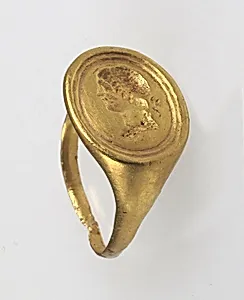
Medium
Gold
Dimensions
Overall: 13/16 x 3/4 x 1/2 in. (2.1 x 1.9 x 1.2 cm)
Classification
Metalwork-Gold
Culture
Frankish
Department
Medieval Art
Museum
Metropolitan Museum of Art, New York, NY
Credit
Gift of J. Pierpont Morgan, 1917
Accession Number
17.191.103
Rights
Public Domain
Tags
Art Historical Context
This exquisite gold finger ring, crafted by an unknown Frankish artisan between 500 and 700 CE, offers a glimpse into the opulent world of early medieval Europe. Measuring just under an inch across, its delicate form exemplifies Merovingian metalwork, a hallmark of the Frankish kingdoms that dominated Gaul (modern France) after the fall of Rome. The ring's bezel likely features finely engraved profile human figures—a common motif in Frankish jewelry symbolizing status, ancestry, or perhaps Christian iconography, as the Franks under kings like Clovis embraced Christianity. Gold was a prized material reserved for the elite, signaling wealth and power in a turbulent era of tribal migrations and kingdom-building. Techniques such as hammering, chasing, and engraving allowed artisans to create intricate designs on such a small scale, blending Germanic traditions with Roman influences. This ring, now in the Metropolitan Museum of Art's Medieval Art collection (gift of J. Pierpont Morgan, 1917), highlights the technical prowess and cultural sophistication of the Franks. Fun fact: Such rings often served as seals or betrothal gifts, whispering stories of alliances forged in gold amid the chaos of the Dark Ages. A tiny testament to enduring craftsmanship!