
Finger Ring
Unknown Artist
7th century
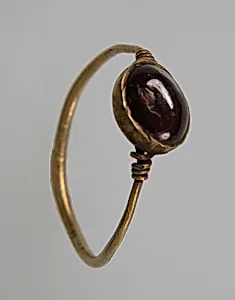
Medium
Gold wire, garnet cabochon
Dimensions
Overall: 13/16 x 11/16 x 3/16 in. (2 x 1.7 x 0.5 cm) bezel: 1/4 x 3/16 x 1/8 in. (0.6 x 0.5 x 0.3 cm)
Classification
Metalwork-Gold
Culture
Frankish
Department
Medieval Art
Museum
Metropolitan Museum of Art, New York, NY
Credit
Gift of J. Pierpont Morgan, 1917
Accession Number
17.192.218
Rights
Public Domain
Art Historical Context
This exquisite 7th-century Frank finger ring, crafted from delicate gold wire and adorned with polished garnet cabochon, exemplifies the refined metalworking of early medieval Europe. Measuring just under an inch in diameter, its slender bezel setting highlights the gem's deep red glow, a testament to the skilled artisans who twisted and shaped the gold into a hoop suitable for daily wear. Housed in the Metropolitan Museum Art's Medieval Art department it entered the collection as a gift from financier J. Pierpont Morgan in 1917. Originating from the Frankish culture—associated with the Merovingian dynasty that ruled much of Gaul during this period—the ring reflects a blend of late Roman traditions and emerging Germanic styles. Gold jewelry like this was a luxury reserved for the elite, symbolizing wealth, status, and possibly personal or familial alliances. The cabochon garnet, uncut and smoothly polished rather than faceted, was a favored gemstone in Migration Period adornments, prized for its vibrant color evoking blood or fire in symbolic contexts. Artistically, the ring's simplicity underscores the era's emphasis on material quality over ornate decoration, showcasing advanced goldsmithing techniques like wire drawing and precise stone setting. For visitors, it offers a tangible glimpse into the daily elegance of Frankish nobility, bridging the classical world and the Middle Ages.