
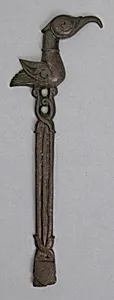
Finial
Unknown Artist
12th century
Medium
Bronze; cast, engraved (?), gilded
Dimensions
H. 8 5/16 in. (21.1 cm) W. 2 15/16 in. (7.5 cm) D. 7/16 in. (1.1 cm) Wt. 3.9 oz. (110.6 g)
Classification
Metal
Department
Islamic Art
Museum
Metropolitan Museum of Art, New York, NY
Credit
Rogers Fund, 1972
Accession Number
1972.230
Rights
Public Domain
Tags
Art Historical Context
This elegant bronze finial, hailing from the 12th century in the Islamic world, stands as a testament to medieval metalworking mastery. Measuring just over 8 inches tall and weighing a mere 3.9 ounces, it was likely designed to crown a staff, standard, or architectural element, adding a touch of grandeur to processions or sacred spaces. Acquired through the Rogers Fund in 1972 and now housed in the Metropolitan Museum of Art's Islamic Art department, it exemplifies the refined artistry of an unknown craftsman from this vibrant era. Crafted from cast bronze, the finial may feature intricate engraving and shimmering gilding, techniques that enhanced its luxurious appeal. Bird motifs, a recurring tag for this piece, adorn its slender form—symbols often evoking freedom, the soul, or paradisiacal gardens in Islamic iconography. The thin depth of just 7/16 inch underscores its delicate, functional beauty, balancing ornamentation with portability. In the context of 12th-century Islamic culture, such metalworks highlighted technical prowess and aesthetic sophistication, bridging utility and spirituality. Visitors can marvel at how this small object once elevated everyday rituals into moments of splendor.