
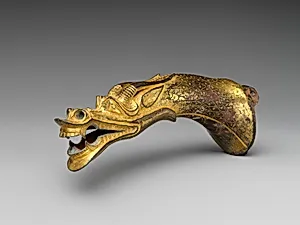
漢 鎏金銅龍頭飾|Finial in the shape of a dragon head
Unknown Artist
1st–2nd century
Medium
Gilt bronze with traces of red pigment
Dimensions
H. 2 1/2 in. (6.4 cm); W. 2 in. (5.1 cm); L. 5 3/4 in. (14.6 cm)
Classification
Metalwork
Culture & Period
China · Han dynasty (206 B.C.–A.D. 220)
Department
Asian Art
Museum
Metropolitan Museum of Art, New York, NY
Credit
Charlotte C. and John C. Weber Collection, Gift of Charlotte C. and John C. Weber, 1992
Accession Number
1992.165.25
Rights
Public Domain
Tags
Art Historical Context
This exquisite gilt bronze finial, shaped as a fierce yet majestic dragon head, hails from China's Han dynasty (206 B.–A.D. 220), a golden era of imperial expansion, cultural flourishing, and technological innovation. Crafted in the 1st–2nd century, it measures a compact 5¾ inches long, perfect for crowning a staff, standard, or ritual object. Dragons like this one symbolized power, good fortune, and cosmic forces in ancient Chinese cosmology, often evoking the emperor's divine authority and control over nature. The artistry shines in its masterful metalwork: cast bronze meticulously gilded for a shimmering golden sheen, with faint traces of red pigment enhancing the dragon's eyes, scales, and snarling mouth. Han artisans excelled in such techniques, layering mercury-gold amalgam fired onto the surface for enduring luster—a testament to their advanced lost-wax casting and polychrome decoration. This fusion of form and symbolism underscores the period's reverence for zoomorphic motifs in elite bronzes. From the Charlotte C. and John C. Weber Collection at The Metropolitan Museum of Art, this finial invites us to glimpse Han China's sophisticated worldview, where mythical beasts bridged the earthly and supernatural realms. A true treasure of Asian Art!