
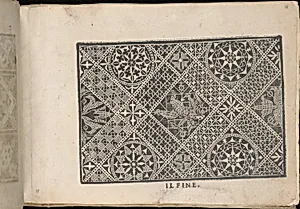
Fiori di Ricami Nuovamente Posti in Luce, page 18 (recto)
Medium
Woodcut
Dimensions
Overall: 5 1/2 x 7 7/8 in. (14 x 20 cm)
Classification
Books|Prints|Ornament & Architecture
Department
Drawings and Prints
Museum
Metropolitan Museum of Art, New York, NY
Credit
The Elisha Whittelsey Collection, The Elisha Whittelsey Fund, 1953
Accession Number
53.547.2(19)
Rights
Public Domain
Tags
Art Historical Context
Step into the intricate world of Renaissance ornamentation with *Fiori di Ricami Nuovamentei in Luce* (Flowers of Embroidery Newly Brought to Light), page (recto), a delicate woodcut print from 1. Created by the Italian publishers Matteo Florimi and Francesco' Franceschi, this modest yet elegant page—measuring just 5½ × 7⅞ inches—showcases floral motifs designed for embroidery and textile arts. Housed in the Metropolitan Museum of Art's Drawings and Prints department, it exemplifies the era's passion for pattern books that democratized sophisticated designs. In late 16th-century Italy, during the waning years of the Renaissance, books like this were essential tools for artisans, embroiderers, and lacemakers. Florimi and de' Franceschi, active in Siena, produced these affordable woodcuts to inspire and standardize decorative motifs across Europe, blending naturalism with geometric elegance. Such patterns influenced fashion, furnishings, and ecclesiastical vestments, bridging art and craft in a time when ornament was a language of status and beauty. The woodcut medium, carved in relief on wood blocks, allowed for precise, repeatable black-line designs ideal for book production and practical use—artisans could trace or adapt them directly. This page's floral "flowers of embroidery" highlights the technique's clarity, capturing the period's fascination with nature's bounty reimagined through human ingenuity. A testament to collaborative printmaking, it invites us to appreciate how everyday creativity fueled Renaissance splendor.
About the Artist
Matteo Florimi|Francesco de' Franceschi (Italian|Italian) · 1581 |1572 –1613 |1622
Italian, active Siena, ca. 1581–died 1613|Italian, Borgo San Sepolcro (Sansepolcro) 1572–1622 Borgo San Sepolcro (Sansepolcro)