
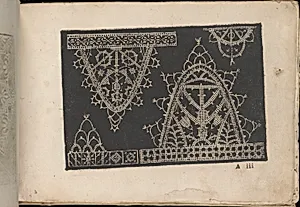
Fiori di Ricami Nuovamente Posti in Luce, page 3 (recto)
Medium
Woodcut
Dimensions
Overall: 5 1/2 x 7 7/8 in. (14 x 20 cm)
Classification
Books|Prints|Ornament & Architecture
Department
Drawings and Prints
Museum
Metropolitan Museum of Art, New York, NY
Credit
The Elisha Whittelsey Collection, The Elisha Whittelsey Fund, 1953
Accession Number
53.547.2(4)
Rights
Public Domain
Tags
Art Historical Context
Step into the intricate world of Renaissance ornament with *Fiori di Ricami Nuovamente Post in Luce* (Flowers of Embroideries Newly Brought to Light), 3 (recto), a delicate woodcut print from 1591. Created by the skilled Italian printers Matteo Florimi of Siena and Francesco de'chi of Venice, this small yet exquisite sheet measures just 5½ x 7⅞ inches (14 x 20 cm). Housed in the Metropolitan Museum of Art's Drawings and Prints department, it the era's passion for pattern books that guided artisans in crafting lavish textiles and decorations. Woodcuts like this one were revolutionary for their time, allowing mass production of finely detailed designs through carving raised images into wooden blocks, inking them, and pressing onto paper. This technique made elaborate floral motifs—likely blooming embroideries here—accessible to embroiderers, lace makers, and architects across Europe. Published in the late 16th century, amid Italy's flourishing decorative arts, the print reflects the Renaissance drive to "bring to light" innovative patterns, blending natural beauty with geometric precision. These ornamental treasures hold cultural weight as bridges between art and craft, standardizing motifs that adorned everything from noble garments to architectural friezes. Gaze closely at its lines, and you'll sense the buzz of workshops where such designs sparked creativity, preserving a slice of 1590s elegance for us today.
About the Artist
Matteo Florimi|Francesco de' Franceschi (Italian|Italian) · 1581 |1572 –1613 |1622
Italian, active Siena, ca. 1581–died 1613|Italian, Borgo San Sepolcro (Sansepolcro) 1572–1622 Borgo San Sepolcro (Sansepolcro)