
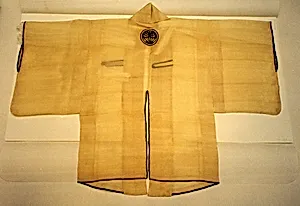
Fireman's jacket, plastron and sash
Unknown Artist
19th century
Medium
Silk, paper
Dimensions
(a.) Jacket: H. including neckband: 39 1/2 in. (100.3 cm); W. 50 1/2 in. (128.3 cm); (b.) Plastron: H. (not including loop or tie) 23 in. (58.4 cm); W. (not including side tabs): 11 3/8 in. (28.9 cm); (c.) sash: H. 2 7/8 in. (7.3 cm); L. 73 5/8 in. (187 cm)
Classification
Costumes
Culture
Japan
Department
Asian Art
Museum
Metropolitan Museum of Art, New York, NY
Credit
Gift of John B. Elliott through the Mercer Trust, 1999
Accession Number
1999.247.9a–c
Rights
Public Domain
Tags
Art Historical Context
This striking ensemble—a fireman's jacket, plastron, and sash—offers a glimpse into 19th-century Japanese urban life, when professional firefighting guilds, known as *hikeshi*, played a vital role in protecting Edo-period (and early Meiji) cities from devastating blazes. Crafted in the Asian Art tradition, these garments were not just functional but symbols of guild pride, worn during dramatic nighttime drills and fires. The jacket's generous dimensions (over 39 inches high and50 inches wide) suggest it was designed for layered wear over other clothing, providing mobility for agile firefighters who climbed rooftops to battle flames. Made of silk and paper, the pieces highlight ingenious Japanese craftsmanship. Silk formed the vibrant outer layer, likely dyed in bold colors for visibility and status, while paper—possibly layered or treated—served as insulation and waterproofing, making the attire buoyant in water and resistant to sparks. The plastron, a protective chest bib measuring about 23 inches high, and the long sash (nearly 74 inches) added reinforcement and secured the outfit during intense action. Housed in the Metropolitan Museum of Art's Asian Art collection (gift of John B. Elliott, 1999), this costume underscores Japan's blend of artistry and practicality, evoking the heroism of firefighters who paraded through lantern-lit streets, turning peril into spectacle.