
Fireplace Surround
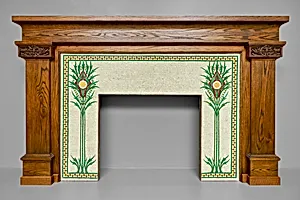
Medium
Oak and glazed earthenware
Dimensions
Surround: 130.8 × 209.6 cm (51 1/2 × 82 1/2 in.); Mosaic: 111.8 × 162.6 cm (44 × 64 in.); Opening: 76.2 × 90.2 cm (30 × 35 1/2 in.)
Classification
mantel (fireplace component)
Department
Arts of the Americas
Museum
Art Institute of Chicago
Accession Number
208516
Rights
Public Domain
About this artwork
Prairie School architect George Washington Maher worked for Joseph Lyman Silsbee before striking out on his own. During this period Maher developed a system of design that he called the “motif rhythm theory,” in which he created a signature motif to harmonize the interior and exterior of a house through the repetition of decorative details based on local natural forms. He frequently collaborated with Louis J. Millet on his commissions, including the Patrick J. King House (1901), from which this ...
Art Historical Context
Crafted in 1901 by architect George Washington Maher, this striking *Fireplace Surround* exemplifies the Prairie School movement's fusion of architecture and fine craftsmanship. Made from rich oak wood paired with vibrant glazed earthenware tiles, the mantel measures an impressive 130.8 × 209.6 cm overall, with a generous 76.2 × 90.2 cm opening that would anchor any early 20th-century American living space. Housed in the Art Institute of Chicago's Arts of the Americas department, it highlights the era's emphasis on harmonious, nature-inspired interiors. Maher, a contemporary of Frank Lloyd Wright, championed horizontal lines, geometric motifs, and integrated ornamentation in his designs, reacting against Victorian excess. The oak frame provides sturdy elegance, while the earthenware mosaic (111.8 × 162.6 cm) adds luminous color and texture, likely featuring stylized floral or abstract patterns typical of Prairie aesthetics. This piece underscores the Arts and Crafts influence, celebrating handcrafted quality in everyday home elements. As a functional yet sculptural mantel, it invites visitors to imagine cozy gatherings in a Maher-designed home, where firelight danced across artisanal tiles. A testament to America's architectural golden age, it reveals how beauty elevated domestic life.