
Firman of Dara Shikoh
Unknown Artist
dated A.H. 1059/1649–50 CE
Medium
Ink on paper
Dimensions
H. 32 13/16 in. (83.3 cm) W. 16 5/8 in. (42.2 cm)
Classification
Codices
Department
Islamic Art
Museum
Metropolitan Museum of Art, New York, NY
Credit
Gift of Terence McInerney, 1997
Accession Number
1997.205
Rights
Public Domain
Art Historical Context
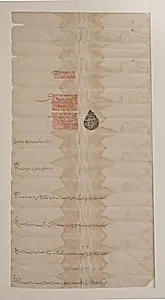
Behold the *Firman of Dara Shikoh*, a majestic imperial decree from the Mughal Empire, dated A.H. 1059 (1649–50 CE). Crafted by an unknown artist in ink on paper, this towering document measures over 32 inches in height, underscoring its ceremonial grandeur. Housed in the Metropolitan Museum of Art's Islamic Department and classified as a codex it exemplifies the refined administrative artistry of 17th-century South Asia. Issued during the reign of Emperor Shah Jahan, the firman bears the name of his eldest son, Dara Shikoh—a prince renowned as a scholar and patron of the arts. At this pivotal moment, Dara was a leading figure in the Mughal court, bridging Persian, Islamic, and Indian traditions through his intellectual pursuits. Such edicts were not mere bureaucracy; they were symbols of royal authority, often adorned with elegant calligraphy to convey power and legitimacy. Artistically, the work highlights Mughal mastery of ink calligraphy on paper, a medium prized for its precision and fluidity. Its large scale allowed for bold scripts, making it both a functional record and a cultural artifact. Gifted to the Met in 1997 by Terence McInerney, this firman invites us to glimpse the splendor of Mughal governance and the prince's enduring legacy.