
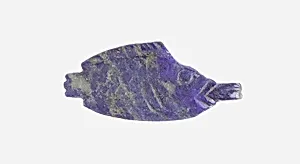
Fish amulet
Unknown Artist
ca. 1550–1295 B.C.
Medium
Lapis lazuli
Dimensions
L. 1.8 cm (11/16 in.)
Classification
Amulet, fish
Period
New Kingdom
Department
Egyptian Art
Museum
Metropolitan Museum of Art, New York, NY
Credit
Purchase, Mr. and Mrs. Dulaney Logan Gift, 1975
Accession Number
1975.35
Rights
Public Domain
Tags
Art Historical Context
This delicate *Fish Amulet*, carved from lapis lazuli during Egypt's New Kingdom (ca. 1550–1295 B.C.), hails from Dynasty 18—a golden age of pharaonic power marked by monumental architecture and artistic refinement under rulers like Thutmose III and Amenep III. Measuring just 1.8 cm long, this tiny masterpiece exemplifies the exquisite craftsmanship of ancient Egyptian jewelers, who transformed precious stones into protective talismans worn daily or placed in tombs. Lapis lazuli, sourced from distant Afghan mines, was a luxury material revered for its deep blue hue evoking the night sky and divine realms. Carved in the round, the amulet's fish form likely served apotropaic purposes, warding off evil or invoking prosperity in the Nile-dependent society where fish symbolized abundance. Such small-scale sculptures highlight the Egyptians' mastery of hard-stone carving techniques, achieving lifelike detail despite the miniature size. Now housed in the Metropolitan Museum of Art's Egyptian Art Department, thanks to a 1975 gift from Mr. and Mrs. Dulaney Logan, this amulet offers a window into everyday spirituality and elite artistry of the ancient world. Visitors, imagine it strung on a necklace, safeguarding its owner through life's perils!