
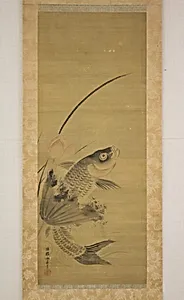
Fish and Lotus
Medium
Hanging scroll; ink and color on silk
Dimensions
Image: 47 1/16 × 18 13/16 in. (119.6 × 47.8 cm) Overall with mounting: 80 11/16 × 24 1/4 in. (205 × 61.6 cm) Overall with knobs: 80 11/16 × 26 11/16 in. (205 × 67.8 cm)
Classification
Paintings
Culture & Period
Japan · Edo period (1615–1868)
Department
Asian Art
Museum
Metropolitan Museum of Art, New York, NY
Credit
The Howard Mansfield Collection, Purchase, Rogers Fund, 1936
Accession Number
36.100.94
Rights
Public Domain
Tags
Art Historical Context
Created during Japan’s Edo period (1615–1868), “Fish and Lotus” is a hanging scroll by Kano Yasunobu, a painter from the long-dominant Kano school. Painted in ink and color on silk, the work measures roughly 47 by 19 inches in its image area and was meant to be viewed vertically, a format that encourages quiet contemplation as the eye travels from top to bottom. The scroll’s silk surface allowed for both precise brush lines and soft washes of color, techniques prized in official and scholarly circles of the time. Kano Yasunobu belonged to a family workshop that supplied paintings to the Tokugawa shogunate and elite patrons. The school blended Chinese-inspired ink methods with Japanese decorative sensibilities, producing images of nature that carried both visual elegance and symbolic resonance. Here, fish glide among lotus blossoms—a motif long associated with purity and renewal—rendered with the balanced composition and restrained palette characteristic of Edo-period Kano painting. Now in the Metropolitan Museum of Art’s Asian Art collection through the Howard Mansfield bequest, the scroll offers visitors a glimpse of the refined natural imagery that adorned temples, residences, and gathering spaces throughout seventeenth- and eighteenth-century Japan.
About the Artist
Kano Yasunobu (Japanese) · 1614 –1685
Japanese, 1614–1685