
Fisherman's Quarter
Medium
Etching on cream laid Japanese paper
Dimensions
Image: 18.7 × 19.8 cm (7 3/8 × 7 13/16 in.); Plate: 19.4 × 20.5 cm (7 11/16 × 8 1/8 in.); Sheet: 25.7 × 31 cm (10 1/8 × 12 1/4 in.)
Classification
etching
Department
Prints and Drawings
Museum
Art Institute of Chicago
Accession Number
46348
Rights
Public Domain
Art Historical Context
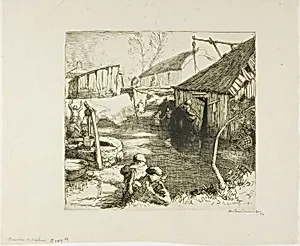
**Fisherman's Quarter** (1915) is a captivating etching by French printmaker Louis Auguste Lepère renowned for his intricate depictions of everyday French life. Created on luxurious cream laid Japanese paper—a medium favored by artists for its smooth texture and ability to hold fine ink details—this work measures a modest 18.7 × 19.8 cm, inviting intimate viewing. Housed in the Art Institute of Chicago's Prints Drawings department, it exemplifies Lepère's mastery of etching, a technique involving acid-bitten metal plates to produce delicate lines and rich tonal contrasts that evoke the weathered charm of a coastal fishing neighborhood. Produced amid the turmoil of World War I, the print offers a poignant glimpse into pre-war tranquility, likely capturing the bustling yet timeless quarter of a French port town. Lepère, a key figure in the late 19th- and early 20th-century etching revival, blended realist precision with atmospheric subtlety, influenced by his background in wood engraving and illustration for publications like *Gil Blas*. His etched lines masterfully suggest salt-kissed facades, narrow alleys, and the play of light on humble dwellings, highlighting the cultural endurance of fishing communities. This gem rewards close inspection, revealing Lepère's technical virtuosity and his affection for humble scenes. A testament to printmaking's democratic appeal, it bridges art and history, reminding visitors of life's quiet rhythms even in uncertain times.
About the Artist
Louis Auguste Lepère · 1849–1918
Louis-Auguste Lepère (1849–1918) was born in Paris on November 30 to the sculptor François Lepère, immersing him early in the artistic world. At age thirteen, he apprenticed in the studio of the English wood engraver Joseph Burn-Smeeton, training there from 1862 to 1867, and later attended drawing courses under Horace Lecoq de Boisbaudran at the Petite École (now École nationale supérieure des art...