
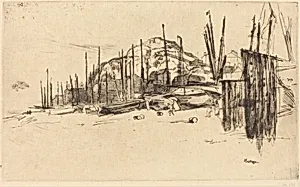
Fishing Boats, Hastings
Medium
etching and drypoint on Asian laid paper
Classification
Department
CG-W
Museum
National Gallery of Art, Washington, D.C.
Credit
Rosenwald Collection
Accession Number
1943.3.8491
Rights
Public Domain
Art Historical Context
James McNeill Whistler’s *Fishing Boats, Hastings* (1877) captures a serene coastal scene from the artist’s time in Hastings, England, a fishing town on the Sussex coast. Whistler, an American expatriate renowned for his Aestheticist principles—“art for art’s sake”—produced this etching during a productive period focused on capturing everyday life with subtle tonal harmonies rather than dramatic narratives. Part of his Hastings series, it reflects his fascination with the sea and working harbors, evoking the quiet rhythm of maritime labor amid misty skies. Printed in etching and drypoint on Asian laid paper, the work showcases Whistler’s mastery of intaglio techniques. Etching provides crisp, precise lines incised by acid, while drypoint adds a soft, velvety burr from direct needle scratches, creating rich textures ideal for atmospheric effects. His choice of Asian paper, prized for its absorbency and subtle laid lines, enhances ink retention and tonal depth, a signature of his printmaking innovation. Housed in the National Gallery of Art’s Rosenwald Collection, this print exemplifies Whistler’s influence on modern printmaking, bridging 19th-century Realism with Impressionist light play. Visitors will appreciate its delicate balance of simplicity and sophistication, inviting contemplation of nature’s fleeting beauty.
About the Artist
James McNeill Whistler · 1834–1903
James Abbott McNeill Whistler (1834-1903) was an American-born painter and printmaker who became a leading figure in the Aesthetic Movement and pioneer of Tonalism and Japonisme. He revolutionized art by championing "art for art's sake" and treating paintings as visual equivalents of musical compositions, titling works as "arrangements," "harmonies," and "nocturnes" to emphasize formal qualities o...