
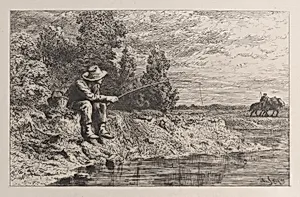
Fishing for Roach
1865
Medium
Etching
Dimensions
Sheet: 12 5/8 × 19 1/8 in. (32 × 48.5 cm) Plate: 5 7/8 × 8 11/16 in. (15 × 22 cm)
Classification
Prints
Department
Drawings and Prints
Museum
Metropolitan Museum of Art, New York, NY
Credit
Harris Brisbane Dick Fund, 1927
Accession Number
27.10.55
Rights
Public Domain
Tags
Art Historical Context
**Fishing for Roach**, a delicate etching by French artist Charles Jacque from 1865, captures serene moment of rural life. Jacque, a prominent member of the Barbizon, was renowned for his intimate depictions of the French countryside, often featuring peasants, animals, and everyday. Here, the composition likely centers on men engaged in fishing for roach common freshwater fish—evoking the rhythms of 19th-century provincial France amid the Industrial Revolution's encroaching changes. Created as an etching on a modest plate (5 7/8 × 8 11/16 in.), the work showcases Jacque's mastery of this intaglio technique. He drew fine lines into a metal plate with acid-resistant ground, then submerged it in acid to etch grooves that hold ink, producing rich, textured prints. This method allowed for subtle tonal variations, ideal for conveying the soft light and intricate details of natural scenes, distinguishing Jacque's prints from bolder paintings by contemporaries like Millet. Acquired by The Metropolitan Museum of Art through the Harris Brisbane Dick Fund in 1927, this piece reflects the era's growing appreciation for realist prints that romanticized pastoral simplicity. Today, it invites visitors to ponder the timeless allure of simple pleasures like fishing, bridging art and everyday heritage.
About the Artist
Charles Jacque · 1813–1894
Charles-Émile Jacque (1813–1894) was a pioneering French painter, engraver, and illustrator whose career bridged the worlds of printmaking and pastoral painting. Born in Paris amid a difficult childhood, he apprenticed at age seventeen to a map engraver, mastering drypoint technique and producing his first etching in 1830—a copy of a head after Rembrandt. After serving seven years in the French Ar...