
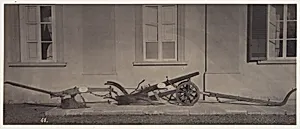
Fissore’s Plow from Tortona, Plow from Parma
Medium
Albumen silver print from collodion negative
Dimensions
Image: 4 7/16 × 10 13/16 in. (11.3 × 27.4 cm) Mount: 12 in. × 17 1/2 in. (30.5 × 44.5 cm)
Classification
Photographs
Department
Photographs
Museum
Metropolitan Museum of Art, New York, NY
Credit
Purchase, The Buddy Taub Foundation Gift, Dennis A. Roach and Jill Roach, Directors, 2015
Accession Number
2015.582
Rights
Public Domain
Tags
Art Historical Context
In 1861, Italian photographer Pietro Semplicini *Fissore’s Plow from Tortona, P from Parma*, a precise albumen silver print made from a collodion negative. This meticulously documents two wooden agricultural plows—one from the Fissore workshop in Tortona, Piedmont, and the other from Parma in Emilia-Romagna—highlighting regional variations in 19th-century Italian farming. Amid Italy's unification (Risorgimento), such photographs preserved vanishing artisanal traditions as mechanization loomed on the horizon. Semplicini's use of the wet collodion process, pioneered in the 1850s, yielded highly detailed glass negatives, which were contact-printed onto albumen paper coated with egg whites for a rich, warm-toned sheen and exceptional clarity. At just 4 7/16 × 10 13/16 inches, the print exemplifies early documentary photography's role in cataloging everyday objects, bridging art and science. Today, housed in The Metropolitan Museum of Art's Photographs Department (acquired through the Buddy Taub Foundation in 2015), this work offers a window into rural Italian life, underscoring photography's power to immortalize humble tools that shaped Europe's agricultural backbone.