
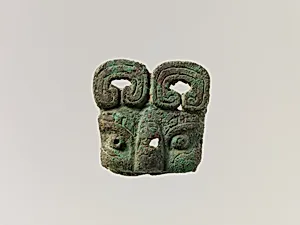
西周 青銅獣面紋飾|Fitting
Unknown Artist
11th–10th century BCE
Medium
Bronze
Dimensions
H. 2 1/8 in. (5.4 cm); W. 2 1/2 in. (6.4 cm)
Classification
Metalwork
Culture & Period
China · Western Zhou dynasty (1046–771 B.C.)
Department
Asian Art
Museum
Metropolitan Museum of Art, New York, NY
Credit
Gift of Paul E. Manheim, 1967
Accession Number
67.43.11
Rights
Public Domain
Tags
Art Historical Context
This exquisite bronze fitting, titled *Western Zhou Bronze Animal Face Pattern Decor* (西周 青銅獣面紋飾), hails from China's Western Zhou dynasty (1046–771 BCE), a golden age of bronze craftsmanship. Measuring just 2⅛ inches high and 2½ inches wide, this small yet intricate metalwork piece likely served as a decorative attachment for chariots, belts, or ritual objects, showcasing the elite status of its owner. Crafted using the sophisticated piece-mold casting technique, it features a stylized animal face—evoking lion-like ferocity through bulging eyes, fangs, and horns—amid swirling motifs typical of the era. In Western Zhou society, bronzes like this were far more than ornaments; they symbolized power, ancestral veneration, and cosmic harmony. The taotie (animal mask) pattern, a hallmark of ancient Chinese bronzes, warded off evil spirits and invoked divine protection during rituals. This fitting reflects the dynasty's refined aesthetic shift from the bolder Shang bronzes, with more angular, geometric designs emphasizing symmetry and restraint. Today, housed in the Metropolitan Museum of Art's Asian Art Department as a gift from Paul E. Manheim in 1967, it offers a tangible link to a world where metallurgy intertwined with mythology, inviting us to ponder the roar of ancient lions in bronze.