
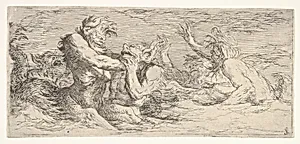
Five battling tritons, from "The Triton Group"
ca. 1660–61
Medium
Etching with drypoint
Dimensions
sheet: 3 3/4 x 8 1/8 in. (9.5 x 20.7 cm)
Classification
Prints
Department
Drawings and Prints
Museum
Metropolitan Museum of Art, New York, NY
Credit
Bequest of Phyllis Massar, 2011
Accession Number
2012.136.300.2
Rights
Public Domain
Tags
Art Historical Context
In the turbulent seascape of *Five Battling Tritons, fromThe Triton Group"*, Salvator Rosa captures a frenzy of mythological mayhem around 1660–61. These half-man, half-fish sea deities—sons of Poseidon in Greek lore—clash with muscular vigor, their twisting bodies evoking the wild power of the ocean. Rosa, a leading 17th-century Italian Baroque artist (1615–1673), infused his works with dramatic energy, drawing from his dramatic landscapes and battle scenes to create prints that pulse with movement and emotion. Crafted as an etching with drypoint, this intimate sheet (3 3/4 x 8 1/8 in.) showcases Rosa's mastery of printmaking. Etching allowed precise, fluid lines etched into a copper plate with acid, while drypoint added velvety burrs for rich, expressive textures—ideal for conveying the tritons' scaly skins and churning waves. Produced late in his career, these prints were innovative for their time, blending painterly freedom with the reproducibility of multiples. Part of Rosa's celebrated "Triton Group" series, this work reflects Baroque fascination with classical mythology and dynamic form, influencing later Romantic artists. Now in the Metropolitan Museum of Art's Drawings and Prints department (Bequest of Phyllis Massar, 2011), it invites visitors to ponder the eternal struggle between chaos and beauty in nature's depths.
About the Artist
Salvator Rosa · 1615–1673
Salvator Rosa was born in 1615 in Arenella, on the outskirts of Naples, into a world of artistic ambition and turbulent talent. His early training came through his maternal uncle, the painter Paolo Greco, and his brother-in-law Francesco Fracanzano, himself a pupil of the great Spanish-born Neapolitan master Jusepe de Ribera. Rosa showed a fierce independence from the start, resisting his father's...