
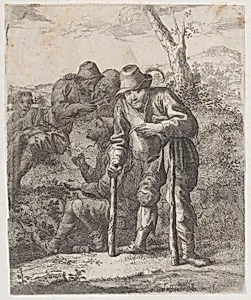
Five beggars in the countryside
ca. 1640–70
Medium
Etching
Dimensions
Sheet (Trimmed): 5 1/4 × 4 5/16 in. (13.4 × 11 cm)
Classification
Prints
Department
Drawings and Prints
Museum
Metropolitan Museum of Art, New York, NY
Credit
Harris Brisbane Dick Fund, 1953
Accession Number
53.600.2379
Rights
Public Domain
Art Historical Context
In the tranquil yet poignant etching *Five Beggars in the Countryside*, created by French artist Jacques Dassonville around 1640–70, we encounter a humble scene of rural hardship. This small print (5¼ × 4⅜ in.), now housed in the Metropolitan Museum of Art's Drawings and Prints department, captures five figures amid a pastoral landscape, evoking the social realities of 17th-century Europe. During this Baroque era, artists increasingly turned to genre subjects like beggars and peasants, blending realism with subtle moral undertones about poverty and resilience. Dassonville's choice of etching—a revolutionary intaglio technique—allowed for intricate lines and tonal depth, etched into a metal plate with acid to produce fine, expressive details. Popularized by masters like Rembrandt, etching enabled affordable multiples while showcasing an artist's drawing skill directly on the plate. The trimmed sheet's intimate scale invites close viewing, drawing visitors into the beggars' weathered faces and ragged forms, a testament to printmaking's power to democratize art. Acquired through the Harris Brisbane Dick Fund in 1953, this work exemplifies the Met's commitment to preserving 17th-century prints that illuminate everyday life. It reminds us how such modest scenes offer profound insights into the human condition across centuries.