
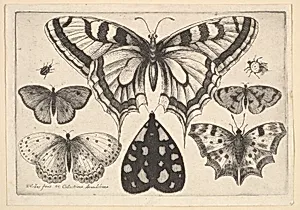
Five Butterflies, a Moth and Two Beetles
Medium
Etching; first state of three
Dimensions
Plate: 3 1/8 × 4 5/8 in. (8 × 11.8 cm) Sheet: 3 7/16 × 4 15/16 in. (8.8 × 12.5 cm)
Classification
Prints
Department
Drawings and Prints
Museum
Metropolitan Museum of Art, New York, NY
Credit
Harris Brisbane Dick Fund, 1926
Accession Number
26.72.124
Rights
Public Domain
Tags
Art Historical Context
In the mid-17th century, Europe's burgeoning interest in natural history during the Scientific Revolution, Bohemian etcher Wenceslaus Hollar created *Five Butterflies, a Moth Two Beetles* in 1646. in Antwerp after fleeing war-torn England, Hollar captured these delicate insects with extraordinary precision on a modest etching plate measuring just 3 1/8 × 4 5/8 inches. This first-state impression—before later revisions—showcases his mastery of line and texture, rendering wings, antennae, and legs in lifelike detail that rivals contemporary scientific illustrations. Hollar, one of the era's most prolific printmakers, produced over 2,500 works, including renowned insect studies that bridged art and emerging entomology. Etching, with its fluid needle work on a grounded plate, allowed him to achieve intricate shading and subtle tonal variations, making these tiny creatures appear vibrantly alive. Such prints were prized by collectors and scholars, reflecting a cultural fascination with the natural world as microcosms of divine order. Today, housed in the Metropolitan Museum of Art's Drawings and Prints department (acquired via the Harris Brisbane Dick Fund in 1926), this gem invites visitors to marvel at 17th-century artistry's power to immortalize nature's fleeting beauty. Up close, the butterflies' iridescent patterns and the beetles' armored forms reveal Hollar's keen observation, a testament to etching's enduring role in scientific visualization.
About the Artist
Wenceslaus Hollar · 1607–1677
Wenceslaus Hollar (1607-1677) was a prolific Bohemian etcher who became one of the most accomplished printmakers of the seventeenth century. Born in Prague, he trained under Matthäus Merian in Frankfurt before entering the service of Thomas Howard, Earl of Arundel, in 1636. Hollar spent most of his career in England, where he produced approximately 2,740 etchings documenting an extraordinary range...