
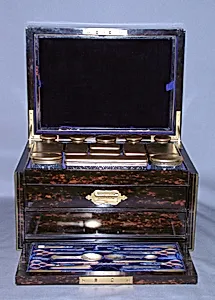
Five jars
1874–75
Medium
Silver gilt, glass
Dimensions
.34,.35) Each: 1 3/4 x 4 1/16 in. (4.4 x 10.3 cm); .36) H. 1 11/16 in. (4.3 cm); .37,.38) Each: 1 5/8 x 2 13/16 in. (4.1 x 7.1 cm)
Classification
Metalwork-Silver
Culture
British, London
Department
European Sculpture and Decorative Arts
Museum
Metropolitan Museum of Art, New York, NY
Credit
Gift of Madame Lilliana Teruzzi, in memory of her mother, 1973
Accession Number
1973.176.34a, b–.38a, b
Rights
Public Domain
Art Historical Context
In the European Sculpture and Decorative Arts galleries of the Metropolitan Museum of Art, visitors encounter *Five Jars* (1874–75), a delicate set crafted by the London silversmith F. P. These petite vessels, measuring just 1⅝ to 1¾ inches high, exemplify the refined metalwork of Victorian Britain. Made of silver gilt—a luxurious technique where a thin layer of gold is applied over silver for a radiant finish—and paired with glass elements, likely for practical containment, the jars showcase the era's mastery of combining functionality with opulence. Produced during the height of London's silver trade in the 1870s, when hallmarks denoted quality and origin, this ensemble reflects the period's emphasis on exquisite domestic objects. Small in scale, they may have graced dining tables as salt cellars, spice holders, or scent jars, blending utility with ornamental appeal in middle- and upper-class homes. The subtle variations in size add harmony to the group, highlighting the silversmith's precision. A generous gift to the Met in 1973 from Madame Lilliana Teruzzi in memory of her mother, these jars invite us to appreciate the enduring allure of British decorative arts—timeless treasures that whisper of 19th-century elegance.