
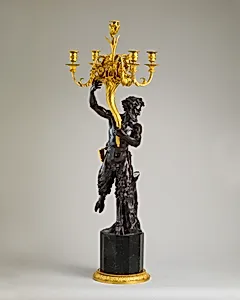
Five-light candelabrum (one of a pair)
ca. 1785
Medium
Gilt and patinated bronze, serpentine marble
Dimensions
H. 45 3/8 x W. 13 1/2 x D. 17 1/2in. (115.3 x 34.3 x 44.5cm)
Classification
Metalwork-Gilt Bronze
Culture
French
Department
European Sculpture and Decorative Arts
Museum
Metropolitan Museum of Art, New York, NY
Credit
Gift of Samuel H. Kress Foundation, 1958
Accession Number
58.75.123
Rights
Public Domain
Tags
Art Historical Context
This exquisite five-light candelab, one of a pair by the renowned French sculptor Clodion (Claude Michel) around 1785, exemplifies playful elegance of late Louis XVI decorative arts. Standing over 45 inches tall on a serpentine marble base, it dynamic gilt and patinated bronze forms, likely animated by frolicsome satyrs—Clodion's signature motif drawn from classical mythology. These mischievous woodland spirits, with their lively poses and sensual curves, evoke the Rococo spirit even as neoclassical restraint emerges in the era's opulent interiors. Gilt bronze, a hallmark of 18th-century French luxury metalwork, was cast, chased, and mercury-gilded to mimic shimmering gold, while patination added rich, verdant tones for depth and realism. The serpentine marble base, veined in green and red, grounds the design in natural luxury, prized for its rarity and association with aristocratic salons. Clodion, a master of terracotta and bronze, infused such furnishings with sculptural vitality, bridging sculpture and decoration. A gift from the Samuel H. Kress Foundation to The Metropolitan Museum of Art in 1958, this candelabrum illuminates the grandeur of pre-Revolutionary France, where myth and opulence lit the twilight of monarchy. Visitors, imagine its flickering candlelight casting shadows of satyrs dancing across gilded walls!