
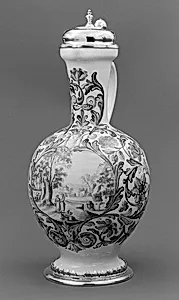
Flagon (one of a pair)
ca. 1690
Medium
Faience (tin-glazed earthenware), silver gilt
Dimensions
H. 13-3/16 in. (33.5 cm)
Classification
Ceramics-Pottery
Culture
German, Nuremberg
Department
European Sculpture and Decorative Arts
Museum
Metropolitan Museum of Art, New York, NY
Credit
Gift of the family of Siegfried and Lola Kramarsky, in their memory, 1991
Accession Number
1991.207.2
Rights
Public Domain
Tags
Art Historical Context
This elegant flagon, one of a pair crafted around 1690 in Nuremberg, Germany by Abraham Helmhack Jacob Pfaff, exemplifies city's renowned tradition of fine ceramics. Standing at 13-3/16 inches tall, it as both a practical vessel for liquids and a luxurious display piece, reflecting the Baroque era's love for opulence and ornamentation. Made of faience—tin-glazed earthenware for its vibrant, durable colors—and adorned with silver gilt accents, the flagon features delicate motifs of women, flowers, landscapes, and trees. The tin glaze allowed artists like Helmhack and Pfaff, likely specialists in enameling, to achieve jewel-like hues and intricate details on earthenware, elevating everyday pottery to the status of fine art. Nuremberg workshops were hubs of innovation, blending pottery with metalworking techniques for such hybrid masterpieces. A gift to the Metropolitan Museum of Art in 1991, this flagon highlights 17th-century German craftsmanship at its peak, where functional objects doubled as status symbols for affluent households. Visitors will appreciate its whimsical yet refined decoration, a window into the refined tastes of Europe's decorative arts golden age.