
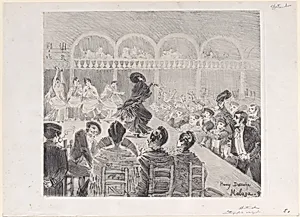
Flamenco dancer in Malaga
1898–99
Medium
Lithograph
Dimensions
Sheet: 10 5/8 × 12 3/8 in. (27 × 31.4 cm) Mount: 12 3/16 × 16 13/16 in. (31 × 42.7 cm)
Classification
Prints
Department
Drawings and Prints
Museum
Metropolitan Museum of Art, New York, NY
Credit
The Elisha Whittelsey Collection, The Elisha Whittelsey Fund, 1963
Accession Number
63.625.331
Rights
Public Domain
Tags
Art Historical Context
Henry Julien Detouche's *Flamenco Dancer inaga* (1898–99) captures the vibrant spirit of Andalusian culture through the lens of a French artist captivated by Spain's exotic allure. Created during the Belle Époque, when European artists romanticized flamenco's passionate rhythms and dramatic poses, this lithograph depicts performers—likely including men and women—in mid-dance, evoking the street scenes of Malaga. Detouche, known for his colorful posters, drew from his travels to infuse the work with authentic energy, reflecting the era's fascination with performance arts amid Spain's cultural renaissance. As a lithograph, the print exemplifies a revolutionary technique perfected in the late 19th century, allowing for bold colors and intricate details through multiple stone plates in chromolithography. Measuring 10 5/8 × 12 3/8 inches on its sheet, it was designed for broad accessibility, bridging fine art and popular posters. Housed in the Metropolitan Museum of Art's Drawings and Prints department, part of The Elisha Whittelsey Collection, it highlights lithography's role in democratizing imagery of global traditions. This piece not only showcases flamenco's roots in southern Spain but also underscores cross-cultural exchange, inviting viewers to feel the dancer's fiery grace and the crowd's infectious joy. A window into 1890s wanderlust!