
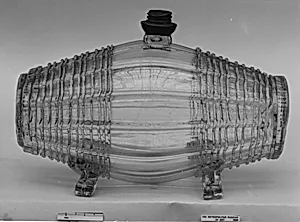
Flask
Unknown Artist
18th century
Medium
Glass, pewter
Dimensions
Overall: 5 × 7 5/8 in. (12.7 × 19.4 cm)
Classification
Glass
Culture
probably Italian, Venice (Murano)
Department
European Sculpture and Decorative Arts
Museum
Metropolitan Museum of Art, New York, NY
Credit
Gift of Henry G. Marquand, 1883
Accession Number
83.7.103
Rights
Public Domain
Art Historical Context
This elegant 18th-century flask, likely crafted in Venice's renowned Murano glassworks, exemplifies the artistry of Italian decorative glassmaking. Standing at just over 5 inches tall, combines delicate blown glass with a pewter mount, blending functionality with ornamental appeal. Murano, a tiny island in the Venetian lagoon, had been Europe's glassmaking epicenter since the 13th century, when the Republic of Venice relocated artisans there to safeguard prized techniques from foreign spies. By the 1700s, Muranese glass was celebrated for its clarity, vibrant colors, and intricate designs, often rivaling fine crystal from across Europe. The flask's classification within European Sculpture and Decorative Arts highlights its dual role as both a practical vessel—perhaps for wine or spirits—and a status symbol for affluent collectors. Pewter accents, common in period pieces, added durability and a touch of luxury, showcasing the collaboration between glassblowers and metalworkers. Donated to The Metropolitan Museum of Art in 1883 by philanthropist Henry G. Marquand, this anonymous masterpiece invites us to appreciate the anonymous skilled hands behind Venice's glittering legacy, a testament to craftsmanship that endures centuries later.