
隋至唐 青瓷扁壶|Flask with molded decoration
Unknown Artist
late 6th–early 7th century
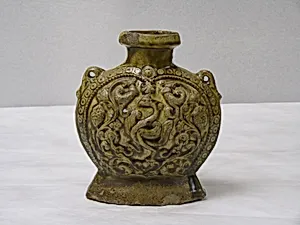
Medium
Stoneware with molded decoration under olive-yellow glaze
Dimensions
H. 8 15/16 in. (22.7 cm); W. 7 5/8 in. (19.4 cm); D. 4 1/4 in. (10.8 cm)
Classification
Ceramics
Culture & Period
China · Sui (581–618)–early Tang (618–907) dynasty
Department
Asian Art
Museum
Metropolitan Museum of Art, New York, NY
Credit
Rogers Fund, 1916
Accession Number
16.165
Rights
Public Domain
Tags
Art Historical Context
This elegant flask, crafted during the late Sui (581–618) to early Tang (618–) dynasty around the late 6th to 7th century, the dawn of China's ceramic golden age. Transitioning from the short-lived Sui unification to the prosperous Tang era, potters developed durable stoneware fired at high temperatures, ideal for everyday vessels like this flattened flask, possibly used for storing liquids such as wine or oil. Its compact dimensions—about 9 inches tall and 7.5 inches wide—made it both practical and portable, blending utility with artistry. The flask's standout feature is its molded decoration under an olive-yellow glaze, a precursor to the famous celadon wares that would define later Chinese ceramics. Artisans pressed the clay into molds to create raised motifs, likely featuring mythical creatures—auspicious symbols evoking protection, power, and harmony in Chinese cosmology. This technique allowed for intricate, repeatable designs, showcasing technical innovation and aesthetic refinement without the need for hand-carving. Housed in the Metropolitan Museum of Art's Asian Art Department since 1916, this piece highlights the cultural bridge between dynasties, where ceramics evolved from functional objects to status symbols. Its subtle glaze, evoking jade's luster, reflects the era's reverence for natural beauty and imperial sophistication, inviting visitors to appreciate the quiet mastery of anonymous Tang craftsmen.