
Flat Iron Holder
c. 1938
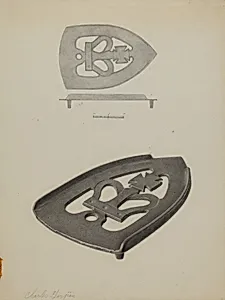
Medium
graphite on paperboard
Dimensions
overall: 28.8 x 21.9 cm (11 5/16 x 8 5/8 in.) Original IAD Object: 6 1/8" long; 7/8" high
Classification
Index of American Design
Department
CG-W
Museum
National Gallery of Art, Washington, D.C.
Credit
Index of American Design
Accession Number
1943.8.15776
Rights
Public Domain
Art Historical Context
Created around 1938 by artist Charles Garjian, *Flat Iron Holder* is a meticulous graphite drawing on paperboard, measuring 28.8 x 21.9 cm. This work renders a diminutive everyday object—a 6 1/8-inch-long, 7/8-inch-high stand designed to hold a traditional sad iron, the heavy, stove-heated tool used for ironing clothes before electric models became commonplace. Garjian's precise lines capture the holder's simple, functional form, likely crafted from metal in an era when such utilitarian items embodied American ingenuity and thrift. As part of the Index of American Design (IAD), a groundbreaking Federal Art Project of the Works Progress Administration (WPA) from 1935 to 1942, this drawing preserves fragments of everyday American material culture amid the Great Depression. The IAD commissioned over 15,000 watercolor, gouache, and graphite renderings by artists like Garjian to document folk art, crafts, and design traditions, fostering national pride and safeguarding heritage for future generations. Housed in the National Gallery of Art's collection, it highlights how ordinary household tools reflected regional craftsmanship and daily life. Garjian's graphite technique emphasizes texture and proportion with scientific accuracy, bridging art and anthropology. Today, it invites visitors to appreciate the quiet artistry in America's vernacular past.
About the Artist
Charles Garjian · 1900–1995
Charles Garjian is an artist whose biographical details are not well established in the major art historical sources. No confirmed dates, nationality, or documentation of his training and working period have been identified in available scholarship, making it difficult to place him with confidence within a particular tradition or movement. The works attributed to Garjian in museum collections sug...