
Flip Glass
c. 1940
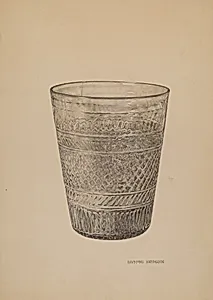
Medium
watercolor, graphite, and pen and ink on paperboard
Dimensions
overall: 35.3 x 24.5 cm (13 7/8 x 9 5/8 in.)
Classification
Index of American Design
Department
CG-W
Museum
National Gallery of Art, Washington, D.C.
Credit
Index of American Design
Accession Number
1943.8.11183
Rights
Public Domain
Art Historical Context
"Flip Glass," created around 1940 by artist Raymond Neumann, is a meticulous rendering of a classic American vessel from the Index of American Design. This watercolor, graphite, and pen-and-ink work on paperboard captures the curves and sturdy form of a flip glass—a traditional mug used for serving "flip," a popular colonial-era cocktail made with beer, spirits, eggs, and sugar, heated with a red-hot poker. Measuring 35.3 x 24.5 cm, its precise details highlight the craftsmanship of early American glassmaking, evoking the everyday elegance of 18th- and 19th-century tavern life. As part of the Federal Art Project under the Works Progress Administration (WPA) during the Great Depression, the Index of American Design (1935–1942) employed artists like Neumann to document the nation's folk art and decorative traditions through vibrant, accurate reproductions. Neumann's technique blends the fluidity of watercolor for rich tones with the sharp lines of graphite and ink for intricate engravings and facets, creating a faithful yet artistic homage that bridges historical artifact and modern appreciation. Housed in the National Gallery of Art, this piece underscores the cultural importance of preserving America's design heritage amid economic hardship. It invites visitors to ponder how ordinary objects like the flip glass reflect social rituals and ingenuity, offering a tangible link to our spirited past.