
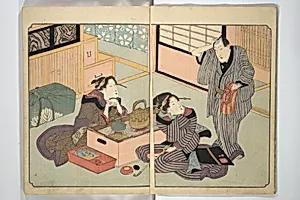
天の浮橋|Floating Bridge of Heaven
ca. 1830s
Medium
Set of three woodblock printed books; ink and color on paper
Dimensions
each: 9 13/16 × 7 1/16 in. (25 × 18 cm)
Classification
Illustrated Books
Culture & Period
Japan · Edo period (1615–1868)
Department
Asian Art
Museum
Metropolitan Museum of Art, New York, NY
Credit
Purchase, Mary and James G. Wallach Foundation Gift, 2013
Accession Number
2013.892a–c
Rights
Public Domain
Tags
Art Historical Context
**Floating Bridge of Heaven (Ten no Ukihashi)**, a captivating set of three woodblock-printed books created by Yanagawa Shigen around the 1830s, the vibrant illustrated book tradition of Japan's Edo period (16151868). Shigenobu, a skilled ukiyo-e artist pupil of the famed Katsushika Hokusai, crafted these intimate volumes with ink and color on paper each measuring about 9 13/16 × 7 1/16 inches. Housed in the Metropolitan Museum of Art's Asian Art Department, this acquisition highlights the enduring appeal of Edo-era print culture. These books feature delicate illustrations of men, women, and couples, rendered in the bold yet refined style of ukiyo-e, which celebrated the "floating world" of everyday pleasures and human connections. Woodblock printing, a revolutionary technique involving carved wooden blocks inked and pressed onto paper, allowed for mass production of colorful, detailed images—making art accessible beyond elite circles. Shigenobu's mastery shines in his nuanced use of color gradients and dynamic compositions, capturing fleeting moments with poetic elegance. Culturally, such illustrated books were prized private treasures during the Edo period, blending artistry with subtle narratives inspired by mythology—like the titular "Floating Bridge of Heaven," evoking divine unions from Japanese lore. They offer a window into the era's social mores, where sensuality intertwined with aesthetic beauty, inviting visitors to appreciate the ingenuity of Japanese printmaking.
About the Artist
Yanagawa Shigenobu · 1787–1832
Japanese, 1787–1832