
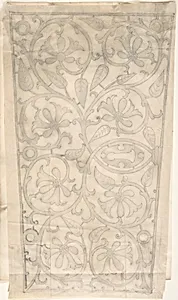
Floral and Foliate Ornamented Metal Keyplate Design
second half 19th century
Medium
Graphite
Dimensions
irreg. sheet: 13 7/16 x 7 7/8 in. (34.2 x 20 cm)
Classification
Drawings|Ornament & Architecture
Department
Drawings and Prints
Museum
Metropolitan Museum of Art, New York, NY
Credit
The Elisha Whittelsey Collection, The Elisha Whittelsey Fund, 1960
Accession Number
60.632.132
Rights
Public Domain
Tags
Art Historical Context
This delicate graphite drawing, titled *Floral and Foli Ornamented Metal Key Design*, captures the intricate beauty of 19th-century British ornamental. Created anonymously in the second half of century, it depicts elaborate motifs of leaves and foliage, intended as a blueprint for a decorative metal keyplate—an escutcheon plate surrounding a keyhole on doors or furniture. The irregular sheet measures 13 7/16 x 7 7/8 inches, showcasing the precision of graphite sketches used by designers to refine patterns before production. In Victorian Britain, such drawings reflected a flourishing interest in historicism and natural forms, drawing from Gothic Revival and Aesthetic Movement influences. Ornamental designs like this were essential for architects, metalworkers, and cabinetmakers, blending functionality with lavish decoration amid the Industrial Revolution's mass production. The foliate elements evoke organic abundance, symbolizing nature's elegance in everyday objects. Housed in the Metropolitan Museum of Art's Drawings and Prints department as part of The Elisha Whittelsey Collection (acquired via The Elisha Whittelsey Fund in 1960), this anonymous work highlights the unsung role of pattern designers. It invites us to appreciate the thoughtful craftsmanship behind the hardware we often overlook, bridging art and architecture in a single, leafy flourish.
About the Artist
Anonymous, British, 19th century · 1800–1900
**Anonymous, British, 19th century** is not the name of a single individual but a standard museum attribution used for works whose creators remain unidentified yet are clearly British and date to the 1800s. Major institutions, including the Metropolitan Museum of Art, employ this designation for hundreds of drawings, prints, designs, and decorative studies that lack signatures or firm documentary ...