
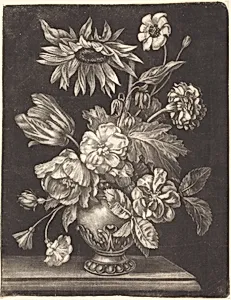
Floral Still Life with a Sunflower
c. 1690
Medium
mezzotint on laid paper
Dimensions
sheet (cut within platemark): 18.2 x 14.4 cm (7 3/16 x 5 11/16 in.)
Classification
Department
CG-E
Museum
National Gallery of Art, Washington, D.C.
Credit
Gift of Christopher Mendez
Accession Number
2007.125.1
Rights
Public Domain
Art Historical Context
In the late Baroque era around 1690, German engraver Elias Christoph Heiss crafted *Floral Still Life with Sunflower*, a delicate mezzotint print on laid paper measuring just 18.2 x 14.4 cm. Heiss, active in Augsburg, was among the early masters of mezzotint—a revolutionary intaglio technique invented in the 1640s that allowed artists to achieve lush, painterly effects through a textured "rocked" copper plate, producing deep velvety blacks and subtle tonal gradations unmatched by earlier engraving methods. This small-scale work captures the opulent beauty of flowers, with the sunflower—a New World import symbolizing admiration and vitality—taking center stage amid a bouquet evoking abundance and transience. Mezzotint's significance lies in its ability to mimic oil paintings' soft lighting and rich textures, making prints like Heiss's accessible luxury items for 17th-century collectors. Floral still lifes were a popular genre in Northern Europe, blending Dutch realism with symbolic depth, often hinting at life's fleeting pleasures (vanitas). Heiss's precise yet atmospheric rendering showcases his skill in translating natural forms into intimate, reproducible art. Today, this gem from the National Gallery of Art's collection (gift of Christopher Mendez, CG-E Prints department) invites visitors to appreciate how printmaking democratized fine art, bridging the gap between elite canvases and everyday wonder.