
Flounce
Unknown Artist
early 18th century
Medium
Bobbin lace, point d'Angleterre
Dimensions
L. 112 1/2 x W. 12 1/2 inches (285.8 x 31.8 cm)
Classification
Textiles-Laces
Culture
Flemish, Brussels
Department
European Sculpture and Decorative Arts
Museum
Metropolitan Museum of Art, New York, NY
Credit
The Mabel Metcalf Fahnestock Collection, the gift of Ruth Fahnestock Schermerhorn and Faith Fahnestock, 1933
Accession Number
33.90.88
Rights
Public Domain
Tags
Art Historical Context
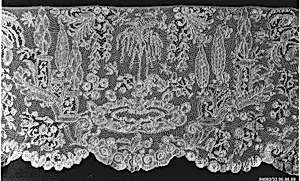
Step into the opulent world of 18th-century fashion with *Flounce*, a stunning example of Flemish bobbin lace from Brussels, crafted by an unknown artist in the 1700s. This exquisite textile measures an impressive 112½ by 12½ inches (285.8 x 31.8 cm), designed a decorative border or ruffle for luxurious gowns. Adorning the edges with delicate floral motifs—evident in its tagged theme of flowers—it captures the lavish ornamental style of the Baroque era's waning grandeur, transitioning toward Rococo elegance. Made in the renowned point d'Angleterre technique, this lace blends bobbin methods with intricate needlework to mimic the crisp, geometric patterns of English lace while showcasing Brussels' mastery. Bobbin lace, twisted and plaited from fine silk or linen threads using small bobbins, demanded extraordinary skill and patience, often produced in specialized workshops. As a status symbol for European aristocracy, such pieces highlighted wealth and refined taste, adorning sleeves, hems, and bodices of elite wardrobes. Housed in the Metropolitan Museum of Art's European Sculpture and Decorative Arts Department (gift of the Mabel Metcalf Fahnestock Collection, 1933), *Flounce* preserves Brussels' legacy as a lace-making powerhouse. Imagine it fluttering on a courtier's dress amid candlelit salons— a testament to craftsmanship that turned thread into wearable art.