
Flounce
Unknown Artist
ca.1700
Medium
Needle lace
Dimensions
L. 120 x W. 23 1/2 inches (304.8 x 59.7 cm)
Classification
Textiles-Laces
Culture
French
Department
European Sculpture and Decorative Arts
Museum
Metropolitan Museum of Art, New York, NY
Credit
The Mabel Metcalf Fahnestock Collection, the gift of Ruth Fahnestock Schermerhorn and Faith Fahnestock, 1933
Accession Number
33.90.137
Rights
Public Domain
Tags
Art Historical Context
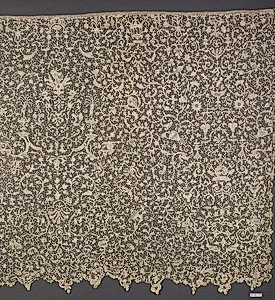
Step into the opulent world of 18th-century French fashion with *Flounce*, a stunning example of needle lace from around 1700. This elongated decorative strip, measuring an impressive 120 inches long by 23½ inches wide, was designed to adorn the edges of garments like skirts or sleeves, adding dramatic flair and elegance. Crafted in France during the lavish reign of Louis XIV, when lace became a hallmark of aristocratic luxury, its delicate floral motifs—evident in the tagged "Flowers" theme—capture the era's love for nature-inspired ornamentation amid the grandeur of Versailles. Needle lace, the medium here, represents the pinnacle of artisanal skill. Unlike bobbin lace, it is created by individually stitching fine linen threads onto a temporary paper pattern, building intricate designs stitch by stitch before dissolving the support. This labor-intensive technique allowed for fluid, sculptural forms impossible with weaving, making pieces like this both wearable art and status symbols. French needle laces, such as those from Alençon, were prized across Europe for their precision and lightness. Today, *Flounce* graces the Metropolitan Museum of Art's European Sculpture and Decorative Arts department, part of The Mabel Metcalf Fahnestock Collection gifted in 1933. It offers a tactile glimpse into the craftsmanship that defined high society, reminding us how textiles wove artistry into everyday splendor.