
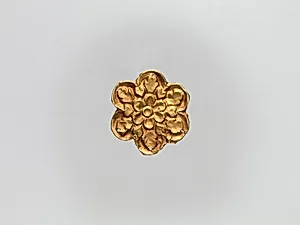
Flower-Shaped Clothing Plaque
Unknown Artist
7th–9th century
Medium
Gold
Dimensions
Diam. 1 1/4 in. (3.2 cm)
Classification
Metalwork
Culture & Period
China (Xinjiang Autonomous Region, Central Asia) · Period of Tibetan Empire
Department
Asian Art
Museum
Metropolitan Museum of Art, New York, NY
Credit
Purchase, The Vincent Astor Foundation Gift, 2002
Accession Number
2002.556.56
Rights
Public Domain
Art Historical Context
This delicate **Flower-Shaped Clothing Pl**, crafted from gleaming gold in the 7th–9th century, just 1 1/ inches in diameter— enough to adorn a garment but radiant with luxurious appeal. Hailing from China's Xinjiang Autonomous Region in Central Asia, this metalwork jewel reflects the sophisticated artistry of a vibrant crossroads culture during the Period of Tibetan Empire. Xinjiang, a key Silk Road hub, buzzed with exchanges between Chinese Tibetan, Central Asian, and nomad traditions. Tibetan imperial expansion into the region during this era brought dynamic influences, evident in such personal ornaments. Worn as a clothing plaque, it likely served as a status symbol, its floral form evoking abundance and beauty—motifs cherished across Eurasian cultures for warding off evil or celebrating nature's bounty. Today, at The Metropolitan Museum of Art (purchased with The Vincent Astor Foundation Gift in 2002), this tiny treasure invites us to marvel at ancient goldsmiths' mastery. Its survival speaks to the enduring allure of portable luxury in a world of vast migrations and empires.